Water management and conservation refers to the strategic planning, development, distribution, and protection of surface and groundwater resources. Although water is constitutionally a state subject in India, the central government provides financial, technical, and digital public infrastructure support to implement demand-based management, scientific aquifer mapping, and community-driven rainwater harvesting.
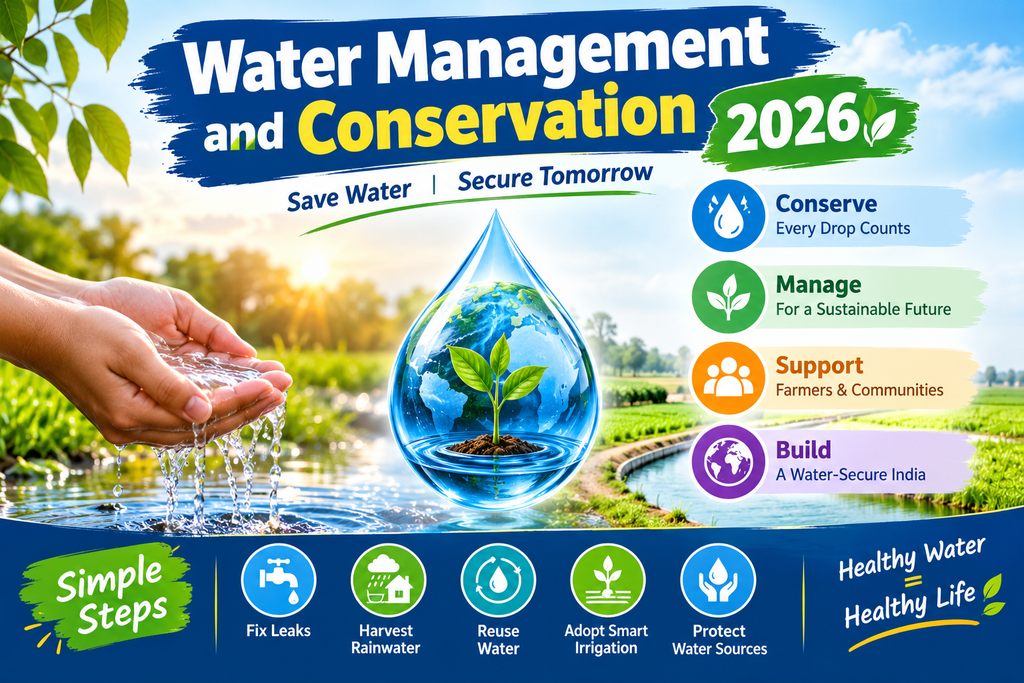
Data/Statistics related to water conservation:
Nationwide Water Body Census: More than 24.2 lakh water bodies across India were identified, counted and geo-tagged to create a scientific baseline for their restoration.
Jal Sanchay Jan Bhagidari (JSJB): More than 1.55 crore artificial recharge and storage structures constructed and geo-tagged across the country by May 2026.
Impact area of Atal Bhujal Yojana: The study covered 8,203 prioritized water-stressed Gram Panchayats spread across 229 blocks in 80 districts of 7 states (Gujarat, Haryana, Karnataka, Madhya Pradesh, Maharashtra, Rajasthan and Uttar Pradesh).
Catch the Rain Progress: More than 20 lakh water conservation and artificial recharge works have been initiated through scheme convergence till July 28, 2026.
Methods of Water Conservation and Management:
Participatory demand-side management: Involving local gram panchayats in water budgeting will allow the focus to be on crop diversification and efficient water use rather than unlimited supply expansion.
Example: Farmers in Atal Bhujal Yojana Panchayats are turning to micro irrigation.
3D GIS Aquifer Mapping and Modeling: Using remote sensing (RS) and geographic information systems (GIS) to map underground water-bearing rock layers.