Groundwater contains 99% of the Earth’s total liquid freshwater, providing a variety of social, economic, and environmental benefits, including climate resilience. In India, groundwater is the primary basis for agricultural activities and drinking water supply, meeting approximately 62% of irrigation needs, 85% of rural consumption, and 50% of urban demand.
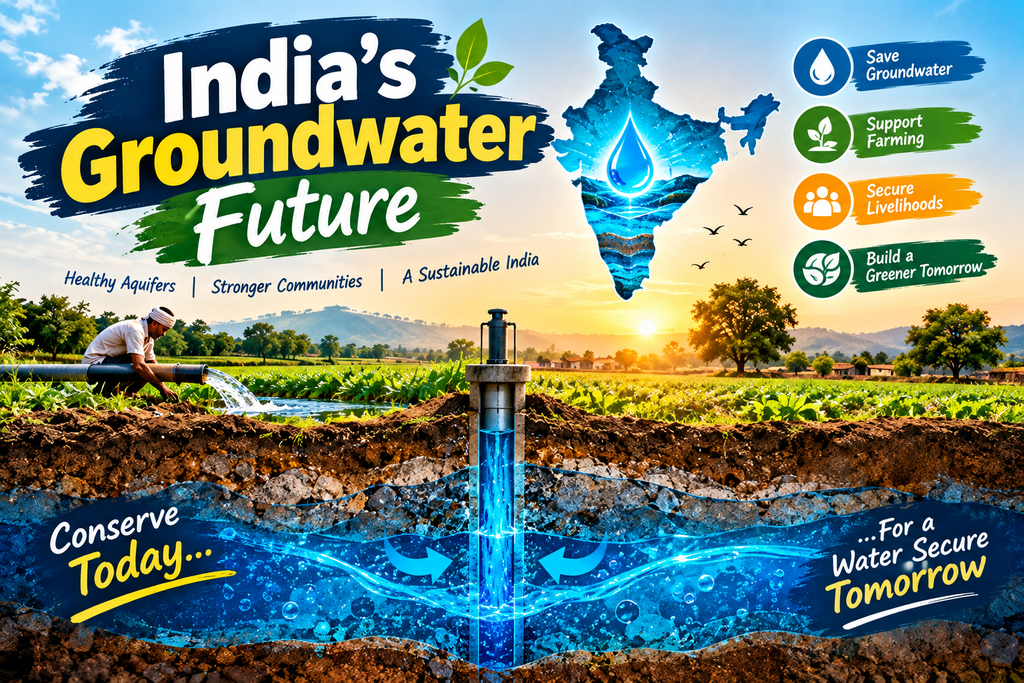
Rapid population growth, agricultural intensification, industrial expansion, and urbanization have collectively increased pressure on groundwater systems in the country. In this context, adopting scientifically informed and sustainable groundwater management practices has become imperative.
While water governance falls within the purview of state governments, the central government, particularly through the Ministry of Jal Shakti and related ministries, plays a facilitative role in conserving, regulating, and strengthening sustainable groundwater management across the country by providing coordinated technical and financial support through various schemes and programs.
Understanding Groundwater
Groundwater is freshwater that percolates into soil and rocks and is stored underground, from where it emerges naturally or is extracted for human use. It maintains the water level of rivers and streams and strongly influences the habitat of plants and animals in wetlands. An underground layer that can store and conduct sufficient quantities of groundwater is called an aquifer. Water from aquifers can flow naturally and contribute to springs, streams, and rivers, or can be pumped through dug wells, tube wells, and bore wells.
Groundwater Management – Elements and Priorities
Groundwater management is part of integrated water resources management and conservation. The fundamentals of groundwater management are: the functions and uses of groundwater (aquifers), the problems and pressures (threats) acting on them, and the impact of management measures on the overall functioning and sustainability of the groundwater system. According to the United Nations Educational, Scientific and Cultural Organization (UNESCO), effective groundwater management requires four key priorities to ensure sustainable and balanced use of groundwater resources.
The need for groundwater management
India has extensive groundwater reserves, whose physical characteristics and availability vary significantly across regions, yet these resources have come under increasing stress in recent decades due to excessive extraction, declining quality, and limited regulation, raising serious concerns about their long-term sustainability.
Degradation of water quality: Pollution from mining activities, industrial waste, and agricultural practices, as well as natural contaminants such as arsenic and fluoride, have progressively impacted groundwater quality, posing long-term environmental and public health risks.
Factors driving uncontrolled extraction: The rapid increase in groundwater extraction has been driven by the availability of affordable drilling and pumping technologies, enabling even small farmers and low-income households to build and operate private tube wells. The growing groundwater crisis has strengthened the government’s commitment to effective management, as confirmed by India’s commitment to climate resilience and sustainable development at COP 21. Effective groundwater management is critical to achieving the Sustainable Development Goals, particularly SDG 6, SDG 11, and SDG 12.