The Atal Bhujal Yojana, a community-led, participatory groundwater management scheme, was implemented on a pilot basis in 8,203 water-stressed Gram Panchayats located in 229 blocks of 80 districts across seven states, including Gujarat, Haryana, Karnataka, Madhya Pradesh, Maharashtra, Rajasthan, and Uttar Pradesh, during the period from 01.04.2020 to 15.10.2025. The scheme was not implemented in the state of Chhattisgarh.
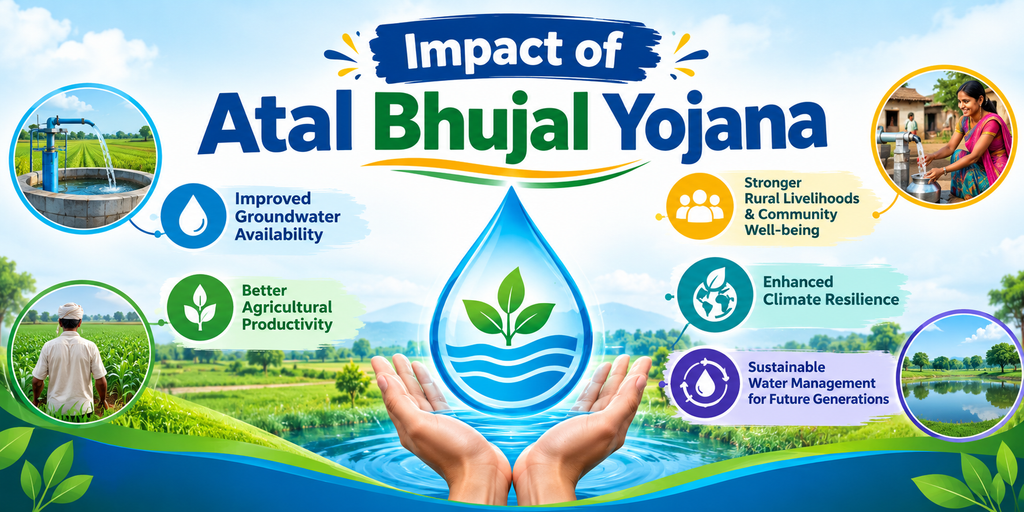
The overall impact assessment study of the Atal Bhujal Yojana was conducted by the Quality Council of India (QCI). Based on detailed field surveys and interactions with local communities in the scheme’s implementation areas, the study identified significant changes brought about by the scheme.
such as increased community awareness on groundwater issues through capacity building and information and communication (IEC) activities, women’s participation in leadership and decision-making in groundwater management, social inclusion, and increased community knowledge and willingness to participate in groundwater conservation and water management. A copy of the report is available on the website of the Department of Water Resources.
State-wise and district-wise details of supply-side structures constructed or renovated for water conservation and groundwater recharge under the Atal Bhujal Yojana are given in Annexure I. A total of 11,622 supply-side structures have been constructed or renovated under the Atal Bhujal Yojana in Maharashtra, of which 589 structures are located in Jalgaon district.
According to assessments conducted during 2023 to 2025, groundwater levels have improved in 180 out of 229 blocks covered under the Atal Bhujal Yojana (ABP), a list of which is given in Annex II. In Maharashtra, groundwater levels have improved in 39 out of 43 blocks covered under the scheme. Furthermore, all four blocks covered under the scheme, including Amalner, Parola, Raver, and Yawal in Jalgaon district of Maharashtra, have improved groundwater levels during the assessment.