How was the Atal Bhujal Yojana conceived?
The Atal Bhujal Yojana was thought of in response to the growing groundwater crisis in India. Groundwater has become a crucial freshwater resource to sustain India’s agriculture and drinking water security, contributing nearly 62% to irrigation, 85% to rural water supply, and 50% to urban water supply.
India extracts as much as 241 billion cubic meters annually—over a quarter of the global total—and this has led to grave overexploitation of groundwater in some states where extraction exceeds groundwater recharge. For example, more than 25 per cent of over-exploited and critical units are concentrated in eight states and UTs, predominantly in the northwestern regions, such as Punjab, Haryana, Delhi, and western Uttar Pradesh. In arid and semi-arid regions of Rajasthan, Gujarat and Punjab too, groundwater extraction is above the annual recharge to meet domestic, irrigation, and industrial water demand. In peninsular India, the hard rock terrain and crystalline aquifers have low storage potential and dependence on groundwater for irrigation, domestic, and industries, means that aquifers run out of water during summer months in regions such as Tamil Nadu, Karnataka, parts of Andhra Pradesh and Telangana, which account for 42 percent of the total over-exploited blocks in the country. This critical crisis has also been fueled by agricultural subsidies, poor crop choices, inefficient irrigation practices and rapid urbanisation.
Falling water tables can also increase the risks of groundwater contamination with pollutants like arsenic and fluorides, which are harmful to health. It also causes land subsidence, with rates exceeding (36 \text{mm/year}) in some cities. Thus, sustainable development and efficient management of groundwater were thought to be extremely important in the years to come. Several examples of sustainable groundwater management involving the community that existed in different parts of India, such as the Pani Panchayat movement in Maharashtra and the Andhra Pradesh Farmer Managed Groundwater System (APFAMGS) project in drought-prone districts of the state, have shown that bottom-up approaches to water management can lead to sustainable use of groundwater at the local levels. A need was thus felt to scale up such efforts to other parts of the country. Realizing the importance of this, the MoJS, GoI, launched the Atal Bhujal Yojana, which envisioned improvement in the groundwater scenario through demand management and community participation in the selected water-stressed areas of seven states in the country.
Atal Bhujal Yojana.
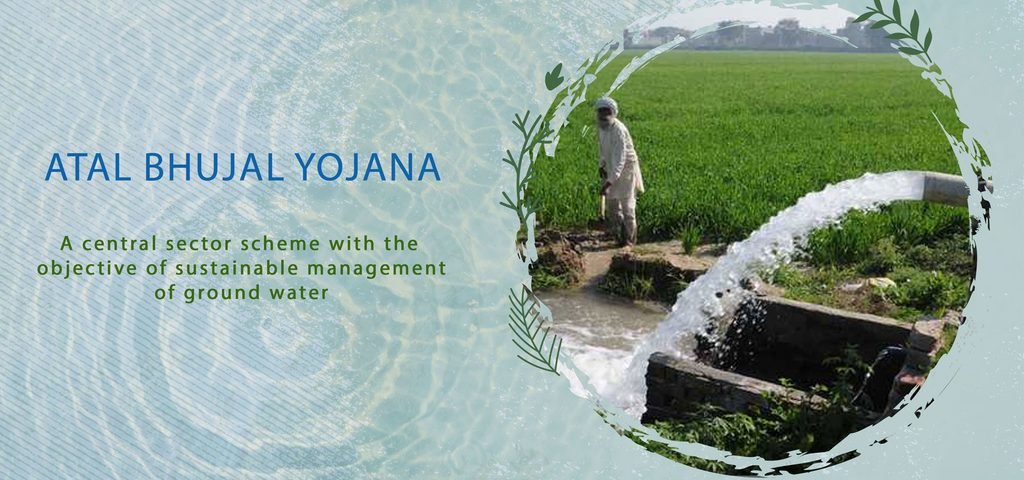
AAtal Bhujal Yojana (Atal Jal), India’s flagship community-led groundwater management programme, was launched in December 2019 by the Ministry of Jal Shakti, Government of India. The scheme initiated institutional reform and aimed at moving away from traditional supply-side solutions towards participatory, data-driven, and demand-focused groundwater governance by empowering Gram Panchayats to lead groundwater planning, supported by real-time data monitoring, hydrogeological mapping, and performance-based incentives. It also advanced national commitments under SDG 6.4 (water-use efficiency) and SDG 6.5 (IWRM implementation). With a total budget of Rs 6000 crore (USD 756.56 million), the scheme was initiated in the water-stressed states of Gujarat, Haryana, Karnataka, Madhya Pradesh, Maharashtra, Rajasthan and Uttar Pradesh.
Q
What were the goals, aims, and objectives of the Atal Bhujal Yojana?
Goal: To demonstrate community-led sustainable groundwater management which can be taken to scale.
Aim: The main aim of the scheme has been to improve groundwater management in select over-exploited and groundwater-stressed areas in identified priority States through implementation of various interventions with community participation.
Objective: To improve the management of groundwater resources in select water-stressed areas in identified states viz. Gujarat, Haryana, Karnataka, Madhya Pradesh, Maharashtra, Rajasthan, and Uttar Pradesh. This was to be achieved by implementing appropriate investments/management actions led by the community through the convergence of various ongoing /new central and State schemes focusing on demand-side management. The scheme also focused on strengthening the institutional framework for participatory groundwater management and bringing about behavioral change at the community level through awareness programs and capacity building for fostering sustainable groundwater management in identified states.