Water is a fundamental resource essential for life, and groundwater has increasingly become a crucial natural resource meeting the freshwater needs of various sectors in India. Groundwater is the backbone of India’s agriculture and drinking water security, contributing nearly 62% to irrigation, 85% to rural water supply, and 50% to urban water supply. However, the sustainable development and efficient management of this limited resource pose significant challenges.
In recent years, several attempts have been made in the country towards sustainable groundwater management by involving the community which demonstrates how demand for groundwater can be reduced if timely information on groundwater availability is provided to communities. Most of these success stories of participatory groundwater management are community driven and self-financed which, at times, become a bottleneck in replicating such initiatives elsewhere.
The Government of India has recognized the potential of community led groundwater management and the need to institutionalize, emphasis on demand side management and behavioral change for ensuring the long-term sustainability of groundwater in the country. The Atal Bhujal Yojana (Groundwater Scheme) is a major step in this direction.
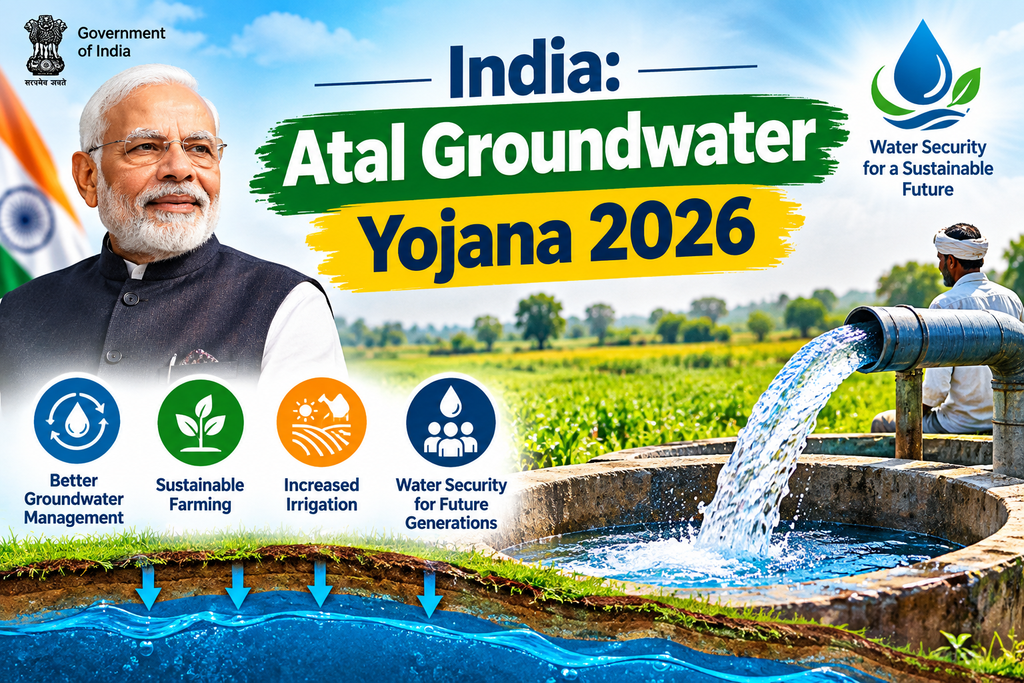
Atal Bhujal Yojana (Atal Jal) Groundwater Scheme with a total outlay Rs 6000 crore (USD 756.56 million) is being implemented by Department of Water Resources, River Development and Ganga Rejuvenation (DoWR, RD&GR), Ministry of Jal Shakti, Government of India. The Scheme is being implemented as a pilot in water stressed areas of seven States viz. Gujarat, Haryana, Karnataka, Madhya Pradesh, Maharashtra, Rajasthan and Uttar Pradesh, with the objective to improve ground water management through participatory approach with a focus on demand management and behavioral changes. The scheme has contributed significantly towards the water and food security of the participating States.
The primary objective of this Scheme is “To improve the management of groundwater resources in the water stressed areas of the selected States”. This will be achieved by implementing appropriate investments/management actions led by community through convergence of various ongoing /new Central and State schemes focusing on demand side management.
- The main aim of the scheme is to improve ground water management in select over-exploited and ground water stressed areas in identified priority States through implementation of various interventions with community participation. The broad objectives of the Scheme are.
- Strengthening the institutional framework in the states to facilitate scientific and sustainable groundwater management.
- Promote the participation of communities and stakeholders in sustainable groundwater management
- To promote activities related to water harvesting, recharging of aquifers and water conservation.
- Supporting efficient water use through new and emerging technologies such as sensor-based irrigation, water-efficient fodder production, use of drones in agriculture, hydrogels and Internet of Things (IoT) enabled technologies, in addition to traditional practices such as drip/sprinkler systems, crop diversification, mulching, etc.