water budgeting is emerging as an important governance tool to ensure sustainable water security in the face of rising water demand, depleting groundwater levels, and climate variability. Systematically accounting for every drop of water helps scientifically plan water use for agriculture, household needs, and animal husbandry, strengthening local resilience and promoting long-term sustainability.
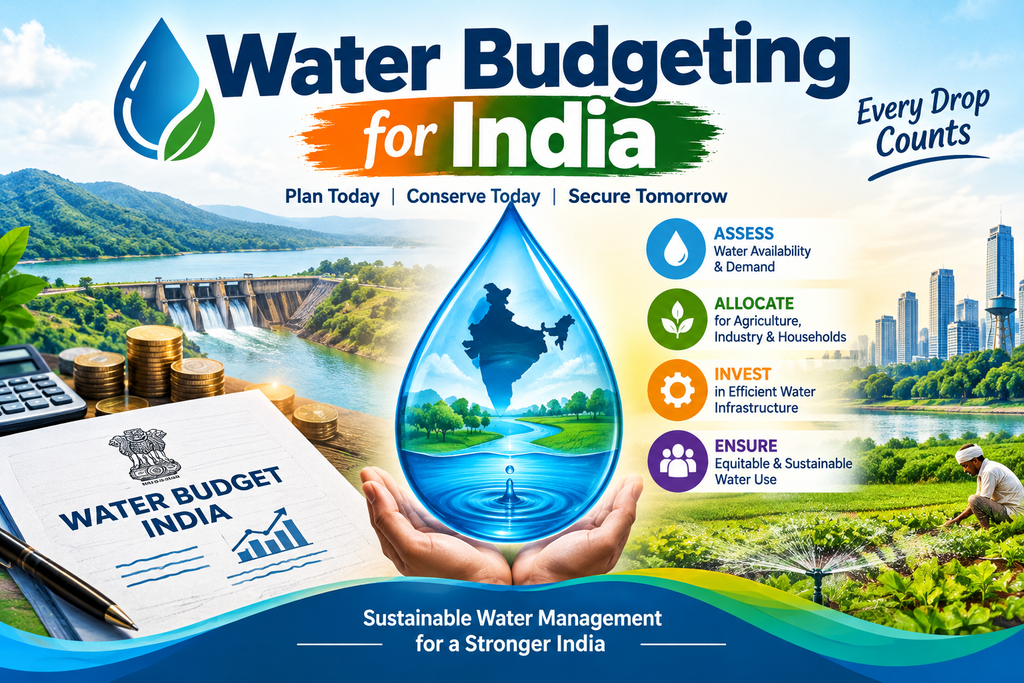
Water Resources in India
- According to the Central Water Commission, India receives about 3,880 billion cubic metres (BCM) of rainfall annually, but only about 1,999 BCM of usable water remains after natural losses.
- India supports 17.5% of the world’s population and 11.6% of the global livestock, putting great pressure on limited water resources.
- Agriculture accounts for about 80–90% of rural water use, making irrigation the largest driver of demand.
- Major challenges include falling groundwater levels, seasonal water stress and conflicts between agriculture, domestic use and industry.
- These challenges highlight the need to move away from supply-side solutions (such as building more dams) to demand-side management, where tools such as water budgeting help efficiently plan and control water use.
Process of Water Budgeting:
It involves a step-by-step process of assessing water availability and demand to ensure balanced, efficient and sustainable use of water resources at the local level.
- Estimating Water Availability (Supply Side): Estimating total water availability from rainfall, surface water bodies (rivers, ponds, reservoirs), and groundwater recharge. The usable water quantity is obtained by subtracting losses such as evaporation, runoff, and seepage.
- Water demand estimation: The total water requirement for sectors such as agriculture, domestic use, animal husbandry, and small industries (where applicable) is calculated. This helps understand the pressure on available water resources.
- Water balance calculation: Total water availability is compared with total water demand. This helps identify whether an area is experiencing a water surplus or a water shortage/stress.
- Planning and Decision-Making: Water balances are used to guide decisions on crop selection, irrigation methods (drip/sprinkler), and water conservation measures. This contributes to water security and sustainable resource planning at the local level.
- Implementation Support: Village Panchayats and local bodies use water budgets to prepare annual water plans and budgets. It also helps monitor water use and implement corrective measures for efficient management.